
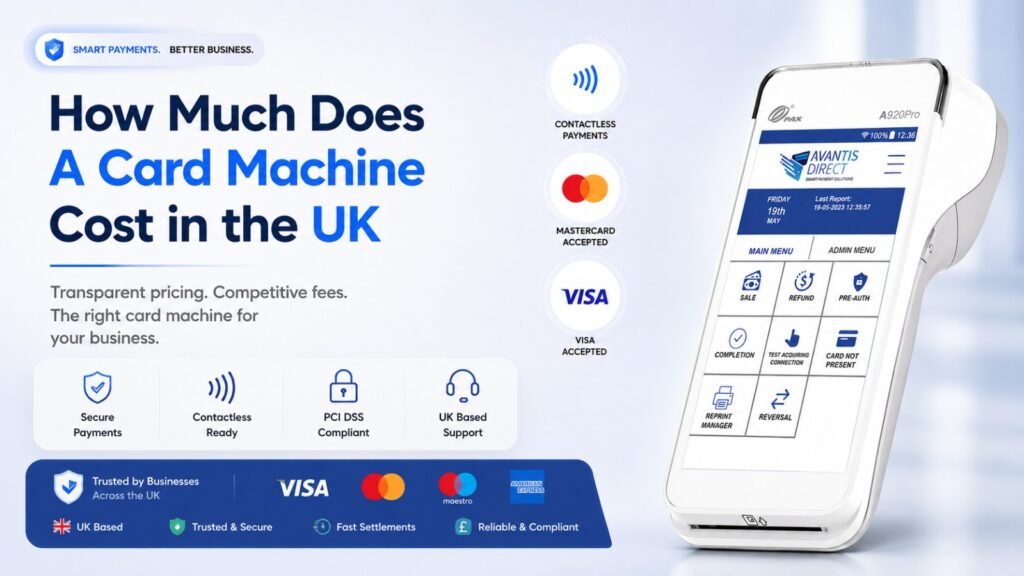
If you run any type of business in the UK from a shop or cafe to a taxi service or a takeaway, you will need to take card payments, be it debit or credit, or even contactless along with Apple or Google Pay. The real question is how much more does your business stand to lose by not having a card machine?
Costs can differ across the border in a range of services including the type of machine, how many transactions you expect, the contract you sign, card machine fees, and with which provider you decide to go with. Some businesses pay a flexible pay-as-you-go pricing plan with no monthly rental fees. Others get lower card machine prices, better support, faster settlement, and more features.
This guide is here to break down all the complex card machine costs for you in simpler terms.
How Much Do Card Machines Cost?
Unfortunately, there is no basic or average price for a card machine in the UK because there is such a range. Some offer card readers at a low cost to them while others are rental based with a monthly service fee.
UK businesses may face the following as part of the total cost of accepting card payments:
- One-off hardware cost
- Monthly rental or service fee
- Transaction fees
- Authorisation fees
- PCI compliance fees
- Chargeback fees
- Early cancellation fees
- Settlement or payout fees
One type of card reader provider charges a percentage of each transaction instead of a monthly fee. Square UK charges 1.75% per card transaction, while SumUp charges 1.69% per transaction.
Other card reader providers adopt a monthly cost model. Clover UK charges a monthly service fee starting at £9.99 and provides the hardware as part of that monthly fee. Clover then sets the cost of each transaction based on the customer’s business.
The total cost to the business may mean card reader hardware with the lowest purchase price isn’t the best choice.
Costs of card readers fall into the following categories:
- Hardware Cost
Businesses must purchase card reader hardware. Basic models generally have a lower cost. Card readers that are EPOS-integrated and print receipts are more expensive.
Small businesses that do not have a high transaction volume may only need a simple card reader. Small businesses that may only require a simple card reader include mobile traders, market stall businesses, taxi drivers, and freelancers. More busy businesses may require a card reader that can handle a higher volume of payment transactions.
Some providers sell the card reader separately from the payment processing service while others bundle the two. Square, for example, sells POS equipment for £19 + VAT, and lists its in-person processing fee separately.
A card reader may be cheap up front, but other factors may justify a higher expense. Consider whether the card reader befits your needs. The drawbacks of a cheap card reader with limited connectivity, no printed receipts, poor battery life, and a slow payment processor could add up to greater expense in lost sales.
Monthly Rental or Service Fees
Monthly service fees are more common for advanced terminals and some merchant service agreements.
Rental of the card reader and monthly fees can include:
- Customer service
- Support
- Software
- Processing reports
- Connectivity
- Replacements
- Upgrades
- Fast settlement of funds
- EPOS or payment integration
Monthly fees are not automatically a bad deal. For a business that processes many credit card transactions, a monthly fee can be justified if transaction costs are reduced and the card processing service is reliable.
Compare costs based on a period such as a month, but also account for the cost of the card reader. A service provider with a low monthly fee but a very expensive card reader can lose you money in the long run.
Transaction Fees: The Cost That Matters Most
Of all the fees related to credit card transactions, the transaction fee is the cost that you will incur and the provider will benefit from the most in the long run. This is the percentage of the card transaction that is retained by the provider.
Say your business’ transaction fees are 1.75%. When a customer pays you £100, your business pays £1.75 to process the payment. While that may seem small, the costs really add up with the monthly sales that your business makes.
To illustrate, assume that your business has monthly credit card sales of £10,000. That would mean that:
- With a transaction cost rate of 1.75%, you pay £175.
- With a rate of 1.50%, you pay £150.
- With a rate of 1.00%, you pay £100.
For businesses with high volume sales that are handled via credit card, like cafés, convenience stores, retail shops, and salons, the savings of 0.25% or 0.50% are substantial and should be considered.
Business owners should make a fare comparison of card machine service rates instead of only looking to buy the cheapest card machines.
Card Machine Fees You Should Consider
To entice customers, some card service providers have deceptively low fees and will then tack on additional fees.
Make sure you assess the following fees before you select card service provider.
Setup fees
Some charge you to set up or install the card service. Others do not charge you.
Monthly minimum fees
You may be charged a shortfall fee if, within a month, you do not meet the minimum amount of card services that the merchant account expects you to process.
PCI compliance fees
There may be a fee to support the merchant account’s compliance with PCI DSS. Some providers include this support.
Chargeback fees
Fees may be charged when a customer disputes a payment and when the provider administers the chargeback.
Early Termination Fees
Early exits from long contracts can be costly. Review the length of the contract and the cancellation terms.
Settlement Fees
Some providers demand payment for settlement at an earlier date. Avantis Direct has next day settlement with no fees and no setup cost or long-term contracts on his card machine service page.
The headline rate is just one aspect of the deal. The hidden terms are usually where the cost is.
Cheap Card Machine Vs Low Card Machine Rates
Many business owners are looking for a cheap card machine for small business purchases which is understandable, especially in the case of a new business. But there is a difference between a cheap device and a cheap payment solution.
A cheap card reader could be:
- Low upfront cost
- No monthly cost
- Quick setup
- Payments via app
Which is great for a business with low or infrequent sales.
However, if a business does card payment sales on a daily basis, the cost of the card machine becomes less important than the transaction costs. A card machine that has a higher cost with cheaper card reader rates could be a more cost efficient solution long-term.
For example, a card reader that costs £30 with a higher transactional cost may be fine for a market stall that occurs once a week. But a restaurant that does card sales of £25,000 a month should be more concerned with transactional cost, card machine reliability, settlement delays, and support.
Avoid selecting a card processing provider based solely on the claim that their rates are the lowest. Ask them to provide their entire fee schedule.
What Determines Card Processing Fees?
The fees vary based on several factors.
Monthly Card Turnover
The higher a business’s card turnover, the better deal they are likely to secure. Businesses with higher monthly card turnover should avoid the flat-rate relationship.
Type of Business
Cafes, bars, takeaways, salons, online stores, and taxis are examples of businesses with disparate payment setups. Pricing may be affected by transaction methods, transaction value, and cost(s) assumed.
Type of Card
There may be a fee to process a card based on whether it is a debit card, credit card, business card, or an international card. There may also be a fee if the card is not present.
Payment Method
Fees may vary based on whether a transaction is keyed in or if it is an in-person payment. Square, for example, has different fees for in-person payments, online payments, and payments processed via their virtual terminal.
Speed of Settlement
Fast settlements are desirable. Next-day settlement may benefit a small business from an operational cash flow standpoint.
Length of Contract
The structure of a business’s needs will determine whether flexible contracts (higher costs) or longer, inflexible contracts (lower costs) will be beneficial.
Example: Low-Volume vs. High-Volume Business
For small businesses like mobile hairdressers, who may only take around £1,500 in card payments each month, getting a basic card reader with no monthly fee may work. Even though the percentage that gets taken as a fee may be higher, their total cost per month may be reasonable.
For a busy take-away, who may take around £30,000 in monthly card payments, the card reader fees can be hundreds of pounds per month. For them, the cost of the card reader, and all its additional features, will be worth it.
This is where most businesses go wrong. They pick the card reader that looks cheapest, only to find out that the transaction fees make it expensive for them.
Are Cheap Card Readers Worth It?
For the businesses that need a basic card payment solution that is quick and easy to setup, like a pop-up shop or mobile service, cheap card readers may be a good option.
They may not work if the business needs:
- Receipt printer
- Longer battery
- Better connectivity
- More user access
- EPOS integration
- Better reporting
- Lower fees for higher sales
- Reliable support
- Fast settlement
While cheap card readers may solve the problem of taking card payments, a good card reader should enable the business to operate and support the customer experience and the businesses cash flow.
Ways to Decrease Costs for Card Machines
To minimize card machine costs, look at the entire package costs, not just the advertised costs.
What you should do:
Examine Fees
Pay attention to the percentage and the fixed transaction charge. The difference may be a small amount, but with large volume transactions, the cost adds up.
Short Contracts Are Better
If conditions change, a long contract can cost your business even more.
Ask About How Fast Funds Become Available in Your Account
Faster fund availability can help your business cash flow. You should still ask about costs increasing.
Be Aware of Fees
Ask about PCI fees, chargeback fees, replacement fees, monthly minimums, and cancelation fees.
Get the Right Machine
Pay for what you need. But make sure you have the right machine if you need one for daily business.
Cost of Card Machines
A the cost of a card machine for a small business in the UK should be based on volume and how payments are accepted.
For very small volume sales, pay-as-you-go card readers make sense. As a business grows, a card machine with a monthly plan may make more sense and be less costly.
The total monthly cost can be estimated as:
Monthly fee + transaction fees + other fees = true card machine cost
You should look at the total cost, not just the cost at purchase. While cheap card machines for small businesses may seem appealing, the true cost is comprised of card machine costs, settlement speed, the terms of the contract, and the quality of service.
Conclusion
Card machines in the UK have pricing that can range from simple monthly plans with charging schemes, to pay-as-you-go pricing. The cheapest option may not be the best option, nor may the most expensive option be the best.
You may find a cheap card reader sufficient for infrequent payments. If daily payments are processed, you should examine the transaction fees, reliability, the speed of settlement, and the support.
Compare the total price, consider the contract terms, and choose a solution that aligns with your business model before you select a provider. Good card machines should support your business with low operational costs and fast payment processing.
We assist UK businesses with comparing card machines to understand fees, and select a payment setup that is the best fit for their trading volume and customer requirements. Knowing the true cost of card readers can help you choose an inexpensive card reader, a portable card payment terminal, or a comprehensive payment solution.